
The Accidental Trekkers: From Cancelled Plans to the Kedarnath Peak
- Oct 1, 2022
- 53 min read
Updated: Feb 12
They say the best adventures are the ones you never planned. In our case, the best adventure was the one forced upon us by a landslide.
Welcome to the latest edition of Wanderlust Foodies.
A year ago, after dragging our tired legs back from our first Himalayan trek, we made a pact: "We will do one trek every year." We are childhood friends from Mumbai who usually bond over Biryani, not frostbite. We prefer comfortable shoes and air-conditioned rooms. But for some reason, we decided to punish ourselves annually.
For Year 2, we thought we played it safe. We booked a "gentle" walk in the Valley of Flowers. It was supposed to be easy. It was supposed to be relaxing.
But the Himalayas had a different menu planned for us.
Twenty hours before departure, a massive landslide cancelled our trip. With bags packed and leaves approved, we made a frantic, last-minute pivot. We didn't choose the hard path; the hard path chose us.
What followed was a 9-day chaotic pilgrimage through the Garhwal Himalayas. It involved a bee sting, a night of terror at 11,000 feet, a relentless hunt for Chicken Curry, and a 22-kilometer climb to Kedarnath that tested our friendship, our lungs, and our sanity.
This is the story of how four average guys accidentally became The Shiva Seekers. Grab a snack (preferably Soya Chaap)—it’s going to be a bumpy ride.
The Prologue: The Great Himalayan Amnesia (Or: Why We Chose Pain Over Goa).
They say childbirth is painful, but humans keep doing it because they forget the agony the moment they see the baby. I am convinced trekking is exactly the same mechanism, just with less crying and more expensive shoes.
A year ago, after dragging our carcasses back from the Har Ki Dun trek, my chaddi buddies (school friends)—Anand (aka Andy), Tejas (aka Teja), and I—sat nursing our soreness, swearing on our lives that we would never walk up a mountain again. We were done. Retired.
Naturally, about six months later, the amnesia set in. The pain faded, the photos looked majestic on Instagram, and the itch returned. We made a pact: "We will do one Himalayan trek every year."
Why we didn't just make a pact to go to Goa every year like normal people, I will never know.
Instead of searching for resorts with swim-up bars, we started Googling places to punish our bodies. We felt we needed to challenge ourselves after years of parties and relaxation. Apparently, we felt we hadn't suffered enough in this life. Thus, the "Bosco Trekkers" WhatsApp group was born, a digital space dedicated to talking about mountains 24/7.
The Recruitment Drive: Finding a Victim.
After our last trek, we marketed the experience to our school friends like we were brand ambassadors for the Himalayas. We conveniently glossed over the lung-busting climbs and focused exclusively on the "spiritual vibes."
Let's be honest, our friends are a lazy bunch. No one bit.
Then, one fine day, the phone rang. It was Jiten (aka Jitu), one of our school friends. "I'm joining you guys too," he announced.
Wow. Our first customer. The first victim of our propaganda. We were ecstatic.
Jitu was immediately added to the WhatsApp group. We all jumped in to give expert advice on gear—what to buy, and more importantly, what not to buy. But Jitu? Jitu went rogue. He bought exactly what he wanted. It was a classic case of “I probably won't use this tactical survival gear, but it looks cool so I’m buying it.”
The Destination: The Valley of Flowers.
With the "fun factor" doubled by Jitu’s arrival, we needed a destination. The problem with Googling treks is the paralysis of choice. Andy, who has a few friends who trek, spent a month just scrolling through photos that looked like Windows XP screensavers.
Finally, for Year 2, we decided to aim for something iconic, beautiful, and—crucially—something that didn't involve climbing a vertical wall. We chose the Valley of Flowers.
Here is the pitch that convinced us (and what we thought we signed up for):
The Vibe: A UNESCO World Heritage Site in Uttarakhand. Meadows! Flowers! Massive Instagram potential!
The Altitude: Between 11,000 ft / 3,353 m and 12,000 ft / 3,658 m. High enough to feel cool, hopefully low enough to keep our oxygen.
The Flora: Home to the Brahma Kamal and Blue Poppy.
The Fauna: Home to Snow Leopards and Asiatic Black Bears. (Spoiler Alert: The only four-legged animals we saw were mules).
The History: Rediscovered in 1931 by British mountaineer Frank S. Smythe after he got lost. (We hoped to emulate the discovery part, not the getting lost part).
Unlike last time, we decided to book a trekking agency where they combine mixed groups. "It’ll be fun," we told each other. "We can make new friends!" (Spoiler Alert 2: Managing our own group of four was hard enough).
The Gear: Decathlon’s Best Customer.
We paid the deposit and booked flights. Then came the gear conversation. "We don't need new stuff. We have gear from last year," Teja and I said, feeling fiscally responsible.
Andy, however, looked at his gear from last year and felt nothing but disdain. He went on a rampage—new shoes, new tracks, new everything. If Decathlon had a loyalty program, Andy would be the CEO.
The "Training" Montage (Or: Why Do Stairs Exist?).
While the internet calls the Valley of Flowers "moderate," we knew that "moderate" in Himalayan terms usually translates to "crying for your mother" for city folks like us. We are entering our early 40s. Our bodies don't recover anymore; they just hold grudges.
So, "Bosco Trekkers" transformed into a fake fitness cult.
Since we live in high-rises, we turned our buildings into gyms. We made a solemn vow: No more elevators. Do you know how stupid you look walking up 5 flights of stairs in formal office wear carrying a laptop bag? My neighbors started looking at me with deep concern. One auntie actually stopped me on the 4th floor to tell me the lift was working fine. I couldn't answer her because my lungs were currently located somewhere in my throat.
We decided we needed "stronger legs." I did 50 squats on Day 1. On Day 2 and Day 3, I walked like a penguin who had ridden a horse for 12 hours straight. Sitting down on the toilet became a tactical mission that required wall support and a silent prayer.
The Team Breakdown:
Andy (The Gear-Head): Andy decided he needed to "break in" his new heavy-duty trekking boots. He wore them everywhere. He claimed he was "molding the sole." I think he just liked the loud clomp-clomp sound they made in the mall.
Teja (The Forrest Gump): Teja adopted the "Long Walk" strategy. He would disappear for hours on weekends, walking aimlessly around the city. He claimed he was building endurance. I suspect he just found a really far-away bakery he liked.
Jitu (The Newbie): Jitu was overflowing with enthusiasm. He kept sending us screenshots: "Guys, I did 10,000 steps today!" We didn't have the heart to tell him that 10k steps on flat pavement to the metro station is very different from 10k steps at 12,000 ft / 3658 m with low oxygen. We let him have his moment.
Me (The Strategist): I focused on "Carb-loading." You know, just in case. You can never have too much stored energy, right?
By the time the trip date arrived, were we fit? No. Were we slightly better at climbing stairs than the average accountant? Maybe.
But our confidence was high, our bags were packed, and our legs were only slightly sore. It was time to go.
Day 0: The 20-Hour Nightmare (Or: The Trek That Wasn't).
The day before departure, we were all cosplaying as responsible adults.
I was stuck in the office, prepping for a critical client meeting and a fancy dinner. Andy was at his clinic, ensuring his tiny patients were stable before handing the reins to his wife (a fellow pediatrician and arguably the smarter half of that power couple). Jitu and Teja, our resident businessmen, were glued to their phones, ensuring their empires wouldn't crumble while they were out breaking their legs in the mountains.
The bags were packed. The out-of-office emails were scheduled with a smug sense of superiority. The excitement was at an all-time high.
Then, exactly 20 hours before our flight, my phone pinged. An email from the trekking agency.
Subject: Important Update: Valley of Flowers.
I opened it, expecting a weather update or a packing tip. Instead, it read: "There has been a massive landslide on the route. The Valley of Flowers trek is officially cancelled."
Imagine you are in the middle of a serious client presentation, nodding along to "ROI" and "synergy," and you read that your vacation has just been deleted. I stared at the screen, my brain refusing to process the words.
I typed back, fingers trembling: "Cancelled? Like... postponed?" They replied instantly: "No sir. Closed. You cannot go."
The Panic Room.
I immediately took a screenshot and dropped it into the "Bosco Trekkers" WhatsApp group. "Guys. The trek is off. I'm in the middle of a client meeting. Will call as soon as I'm free."
Chaos ensued. Andy: "Are you sure? Don't play a prank on us." Teja: "Is this a joke? Because it's not funny."
As I was trying to explain the intricacies of a "Transformation Strategy" to my client, my phone started vibrating off the table like a possessed object. It was Andy.
I excused myself, ran to the corridor, and whispered-shouted into the phone: "Andy, I am in a meeting! The mountain is closed! I can’t talk! Talk to the others! Please fix it!" and hung up.
Back in the meeting, my phone kept buzzing. "But... our flights? They are non-refundable!" Teja panicked. "What do we do with all this gear?" "Do we just... not go?"
Jitu (who had finished work early) and Andy met up in person to form a Crisis Management War Room. They called the agency. The agency confirmed it: The Valley is gone.
We were stuck. We had tickets to Dehradun, a week off from work, and absolutely nowhere to go. We were all dressed up with literally no mountain to climb. The idea of sitting in a hotel room in Dehradun for a week watching cable TV sounded more depressing than the landslide itself.
The "Hail Mary" Pass.
Andy and Jitu frantically Googled "Treks near Dehradun that aren't closed," but everything was either booked out, rained out, or too far. Then, Andy remembered a contact. A guy who knows a guy who knows the mountains.
He made the call. This "fixer"—a local operator in Uttarakhand who specializes in last-minute miracles—picked up. "Don't worry, Sir," the fixer said smoothly. "Valley of Flowers is closed, but the abode of Shiva is always open."
He proposed a "Mix-Tape" Itinerary. It wasn't a standard trekking package; it was a greatest hits compilation of the Garhwal Himalayas:
Deoriatal: The lake of the gods.
Tungnath: The highest Shiva temple in the world.
Kedarnath: The ultimate pilgrimage.
It wasn't the gentle flower walk we had planned. It was steeper, higher, and tougher. But we were desperate. "Let's do it," Teja said.
The Blind Approval.
Meanwhile, I was sitting at a lavish dinner with my client, nodding politely while my phone exploded in my pocket. Andy messaged: "We need confirmation NOW to book the car and hotels." I ignored it. Andy called. I ignored it. Andy called again.
I finally excused myself to the restroom and answered. "Girish, read WhatsApp and confirm quick," he barked.
I didn't even read the itinerary. I just wanted to go back to my appetizers. "I will go with whatever you guys decide," I said. "Just book it."
Famous last words.
After dinner, I waved a professional goodbye to the client and immediately grabbed my phone to actually read the messages. I scrolled through the new itinerary: Deoriatal... Tungnath... Kedarnath...
I froze. A familiar feeling of dread washed over me. It was exactly like last year. I stared at the screen and whispered to myself, "What did I just sign up for?"
The Great Repack.
By 9:00 PM, everything was booked. A car for 7 days, hotels, homestays—the works. The new route: Dehradun > Haridwar > Sonprayag > Saari > Deoriatal > Chopta > Tungnath > Kedarnath > Devprayag > Dehradun.
And here is where we made our first critical mistake. Since this technically wasn't a "trekking expedition" anymore (in our twisted logic, at least), we decided: "Hey, let's ditch the backpacks."
We swapped our practical trekking rucksacks for heavy luggage bags. We threw in jeans, extra shirts, and "city clothes" because we thought we were just going on a road trip with some walking involved.
By 10:00 PM we were set. We had the wrong bags, zero preparation for this specific route, and 100% enthusiasm. The "Flower Watchers" had officially become the "Shiva Seekers."
Day 1: Mumbai to Haridwar — Seeking Salvation, Finding Street Food.
Despite the chaos of the previous day, we woke up with the kind of energy usually reserved for toddlers on a sugar rush. Our flight wasn't until 11:30 AM—a civilized hour—but who can sleep when the mountains are calling? (Or when you’re terrified you might have booked the wrong hotels in a panic).
Andy came with his driver to pick us up. I was the first pickup, and then we roared off to collect Jitu. When Jitu walked out of his building, I had to double-check if we were going to the Himalayas or digging for dinosaur bones. He was wearing a jacket with unlimited pockets. He looked less like a trekker and more like an archaeologist prepared to smuggle ancient artifacts. I am pretty sure he had a pocket specifically designed for a sandwich and another one for a compass he didn't know how to use.
The Teja Situation: Teja used to be a Borivali boy, but after getting married, he betrayed the brotherhood and moved to the Eastern suburbs. So, while we enjoyed our car ride, Teja had to make his own solo pilgrimage to the airport.
We all converged at Mumbai's Domestic Airport (T1). Check-in was quick, security was a breeze, and we immediately rushed to our favorite place in the entire world: The Lounge.
The Priority: Complimentary Food.
Who in their right mind would miss complimentary food? None of us. We settled in, plates piled high with idli, sambar, and muffins, looking extremely pleased with ourselves. We were laughing, eating, and generally acting like we owned the airport. Andy was mid-sentence in a story when the PA system crackled.
"Last and final call for passengers Anand, Girish, Jiten, and Tejas..."
We froze. Muffin crumbs fell from our mouths. The blood drained from our faces. We abandoned the free coffee, grabbed our bags, and ran. We ran faster than Animesh Kujur. We ran faster than we would ever run on the actual mountains.
The Walk of Shame. We boarded the flight breathless, sweating, and likely smelling of sambar. You know that look the other passengers give you? The one that says, "Oh, so YOU are the idiots holding up the takeoff?" Yeah, we got that look from 180 people simultaneously. It felt like we had stolen the keys to the plane.
But shame is a temporary emotion. As soon as we buckled in, the jokes started. No one on that flight knew that 20 hours ago, we had no trip. To them, we were just annoying latecomers. To us, we were the "Shiva Seekers" on a mission.
Dehradun: The Cool Down.
We landed at Jolly Grant Airport, Dehradun, and as soon as the doors opened, a 20-degree breeze hit us. For anyone living in Mumbai, 20 degrees isn't "weather." It is a luxury. Coming from the humid furnace of a Mumbai summer, this felt like stepping into a walk-in fridge. It was glorious.
Dehradun Airport
We collected our bags—which were suspiciously heavy since we packed jeans instead of trekking pants—and threw them into the taxi. Next stop: Haridwar.
The Holy (and Hungry) City.

Haridwar is often called the "Gateway to God." It is one of India's seven holiest cities, located exactly where the River Ganges crashes out of the Himalayan foothills. It is famous for its spiritual energy, the massive Kumbh Mela, and—as we were about to discover—an aggressive amount of calories.
We checked into Hotel Le ROI near the railway station. For once, Andy made a solid logistical decision. It was central, clean, and most importantly, close to the food. We dropped our heavy (and incorrect) luggage and headed out.
The Spiritual Part: Har Ki Pauri. Haridwar is intense. Since alcohol and meat are strictly banned in the holy city, the locals channel all that pent-up energy into spirituality and dairy products.
We headed straight to Har Ki Pauri, the famous ghat where it is believed Lord Vishnu left his footprint. It was time for the Ganga Aarti. The crowd was endless. It wasn't just a prayer; it was a synchronised spectacle of giant fire lamps, chanting, and ringing bells. We had to use some mild tactical maneuvering to grab a spot and "hold our ground" against the tide of devotees. It was mesmerizing, loud, and incredibly powerful.
4 guys at Har Ki Pauri Ganga river Ganga aarti spot Bosco Boys Ganga aarti Har Ki Pauri
The Important Part: The Hogging. By the time the Aarti finished, our spiritual tank was full, but our actual tanks were empty. We looked at each other. No words were spoken. The telepathic connection was established: It was time to eat.
Andy flagged down one of those silent, electric autos. "Market. Food. Fast," we commanded.
Ten minutes later, we were in the labyrinth of narrow lanes (galis) near Moti Bazar. Haridwar doesn't do "food courts." The whole city is an open-air buffet where shops have been selling the same item for four generations.
The Strategy: To maximize efficiency, we adopted the "Share and Conquer" protocol. We bought one plate of everything and split it four ways.
Bedmi Pooris: Deep-fried goodness served with spicy potato gravy (aloo sabzi) and a pumpkin mash (kaddoo ki sabzi) that changed my life.
Khasta Kachori: A hard, deep-fried pastry filled with lentils, drowned in tangy tamarind chutney.
The Dairy Situation: Since there is no beer, Haridwar takes milk very seriously. We hit the Lassi stops hard.
Rabri Jalebis (The Finisher): Thickened, sweetened milk (Rabri) paired with hot, crispy Jalebis. It was a sugar coma waiting to happen.
Jitu with samosa Samosa's in making Teja with samosa pickles
The "Walk" (A Lie We Told Ourselves).
We decided to walk back to the hotel instead of taking an auto. Official Reason: "We need to digest this heavy food." Real Reason: "If we walk, we might find more food on the way."
We scanned the streets, but having successfully eaten the entire city inventory, we found nothing new. So, naturally, we walked into a local restaurant for "Dinner."
Yes. Dinner. Apparently, all that street food was just "Snacks."
We ordered a plate of sabzi each, rotis by default, and rice to follow. By the time the bill came, we were done. We were physically unable to bend at the waist. We waddled back to the hotel, completely stuffed.
Dinner spread Dinner plate
The real journey—and the long drive—was starting tomorrow. But for tonight, we slept the sleep of the well-fed.
Day 2: Haridwar to Sonprayag – Mountain Math & Near-Death Experiences.

Thanks to the absolute devastation we wreaked on Haridwar's food supply last night, we slept like logs. But the mountains don't care about your food coma. You need to be up early.
Our driver was scheduled for 8:00 AM. We dragged ourselves out of bed by 7:00, freshened up, and faced the reality of our choices. Breakfast Status: Skipped. Why:
We were still digesting yesterday’s Jalebi overdose.
We were about to hit twisting mountain roads, and nobody wanted to decorate the car upholstery with yesterday’s dinner.
At sharp 8:00 AM, Andy's phone rang. "Sir, mein gate pe hoon." (Sir, I am at the gate). In India, a driver being on time is the first genuine miracle of the trip. We did a quick "idiot check" (chargers? toothbrushes?), loaded our bags (which were still annoyingly heavy), and set off.

Next stop: Sonprayag.
The Mountain Math.
If you check Google Maps, Sonprayag is about 230 km from Haridwar. In Mumbai, 230 km is a nice Sunday drive. You hit the expressway, blast some music, and you’re there in 4 hours.
But we aren't in Mumbai anymore. We are in the Himalayas. And here, Mountain Math applies. 230 km = 8 to 9 hours. Minimum.
The road isn't a road; it’s a suggestion. We traded straight highways for twisted ribbons of tarmac, gravel patches, active landslide zones, and cliffs that drop straight into the river below. Every turn makes you think two things:
"Wow, nature is beautiful."
"I hope this is not my last day on earth."
The Smooth Start & The Panic.
The first hour was a lie. The drive through the foothills was smooth as butter. We were relaxing, enjoying the fresh air from open windows, thinking, "Hey, this mountain driving isn't so bad."
Then, the roads started curling up like a snake. Suddenly, a crisis hit. It wasn't a flat tire. It wasn't a lost map. Someone shouted from the back seat: "Bhai, daru nahi liya!" (Bro, we didn't buy booze!).
There was a collective gasp. We were heading into the wilderness without supplies. Our driver, sensing the genuine panic in our voices, immediately reassured us. "Sir, aage ek theka hai." (Sir, there's a wine shop ahead). God bless this man. We stopped, stocked up on "essential warming fluids" (rum), and Jitu asked the golden question: "Bhai, on the way ke liye?" By default, the answer was Beer.
Girish with beer Jitu with beer
Himalayan Multitasking. With the car loaded, we continued. But the mountain gods were done being nice. The pattern became predictable: Good Road → Landslide → Prayer → Smooth Road → Repeat.
We mastered the art of Himalayan Multitasking: Clutching the "Oh Sh*t" handle with the left hand, and a cold beer with the right. We looked out at the terrifying drop, took a sip, and smiled nervously.
Devprayag: The Birthplace of the Ganga.
After two hours of holding onto our lives, we reached Devprayag. This is the delivery room of the River Ganga. Before this point, the river doesn't technically exist. Two separate rivers—the Bhagirathi (turbulent and muddy brown) and the Alaknanda (calm and emerald green)—crash into each other here. From this specific point onwards, they merge and officially become the Ganga.
Devprayag
It’s a visual spectacle. You can literally see the two personalities colliding. We stopped to stretch our legs, breathe air that didn't smell like car upholstery, and grabbed some local snacks.
Dhari Devi: The Guardian & The Wrath.
Another 1.5 hours of winding roads brought us to Dhari Devi. We stopped for chai but ended up getting a lesson in local mythology that sent a chill down our spines.
The Dhari Devi Temple sits right in the middle of the Alaknanda River. To the locals, she is the Protector of Uttarakhand—the spiritual security guard of the Himalayas. The legend is fascinating:
The Changing Face: Locals believe the idol changes appearance from a girl in the morning, to a young woman in the afternoon, to an old lady in the evening. (Kind of like us after a long day at work, but divine).
The 2013 Flood Legend: This is the scary part. In 2013, to make way for a hydropower project, officials moved the idol. Hours later, the massive Kedarnath cloudburst occurred. Locals firmly believe the disaster was the Goddess's wrath.
We looked at the river with a lot more respect after that story, finished our tea, and decided this moment definitely called for a respectful photo from a safe distance.
Dhari Devi Temple Andy with Dhari Devi temple Teja with Dhari Devi temple Girish with Dhari Devi temple
The Medical Emergency (The Bee Incident).
Post-lunch, we moved toward Ukhimath. To keep things fresh, we initiated the Great Seat Swap. Teja took shotgun. Andy and I took the middle row. Jitu, in a moment of madness, chose the third row to cuddle with our suitcases.
About an hour later, disaster struck. A bee—an assassin with wings—flew in through the window and stung Andy right on the chest.
I was sitting next to him, so I had a front-row seat. Imagine the face of a man having a massive heart attack—eyes wide, mouth open in a silent scream, hand clutching the chest. Now, put that face on Andy. I froze. My brain went from 0 to 100 in panic. “Is he having a cardiac arrest? Do I know CPR? Oh wait, HE is the doctor!”
I shouted at the driver, "ROKO! ROKO!"
The Diagnosis. The driver slammed the brakes. Andy gasped, "A bee bit me. It's burning." We immediately turned to Dr. Google. We showed him pictures. Verdict: A Garden Bumble Bee (Bombus hortorum). Prognosis: Not deadly, but can cause severe swelling.
The Doctor Becomes The Patient. The irony was thick. Andy is usually the one saving people. Now, he was the patient, and the three of us (two businessmen and an IT guy) were staring at him cluelessly. But Andy is a pro. Even in pain, he barked orders. "Girish, pull out the allergy medicine." He self-medicated, we monitored him for 20 minutes to ensure he didn't puff up like a balloon, and once the burning subsided, we got the thumbs up. We climbed back in, hermetically sealed the windows, and moved on.
Ukhimath: The Winter Seat.
Two hours later, we rolled into Ukhimath. If Devprayag is the birth of the Ganga, Ukhimath is the Winter Vacation Home of the Gods. When the main Kedarnath temple closes for winter due to snow, the symbolic idol of Lord Shiva is brought down here. Basically, if you visit in winter, you get the blessings without the frostbite.
We checked into a Homestay—no Hiltons here, just local homes with good food. We split up. Andy and I took one room; Teja and Jitu took the other.
The Resurrection of Andy. The temperature outside had dropped to below 10°C. We were shivering in the room when a strange sound filled the air. It was music. I looked over. Andy—our "critical patient" from two hours ago—was sitting on the edge of the bed, perfectly fine, playing a mouth organ. "Since when do you play the mouth organ?" I asked, stunned. He just smiled and kept playing. Apparently, near-death experiences unlock hidden talents.
The Mountain Dinner. By 8:30 PM, dinner was served: Rice, Dal, and Sabzi. We learned from our last trek that in the mountains, hot Dal Chawal tastes better than a Michelin-star meal.
The cold air and the 12-hour journey finally caught up with us. By 10:30 PM, we were buried under heavy blankets. The road trip was done. The real challenge was about to begin.
Next day: The climb towards Kedarnath awaits.
Day 3: The Natural Car Wash, The Emerald Mirror, and The Night of the Singing Bee.
I woke up at 7:00 AM, but my body refused to acknowledge it. The cold was simply too disrespectful for a Mumbaikar. My blanket was my best friend, and I had no intention of betraying it.
I looked over at Andy. He was fast asleep. "If the doctor is sleeping, the patient (me) should also rest," I told myself. A few minutes later, he stirred. He looked groggy, pale, and definitely not like the guy playing the mouth organ last night. "Yaar, I'm not feeling well," he whispered.
The bee venom, the travel fatigue, and the sudden drop in temperature had done its "magic" overnight. The mountains were hazing him. "Andy, tu so ja," I said, tucking him back in. "We will figure out the plan later."
Just then, Jitu knocked, fully dressed and annoyingly energetic. I stepped out into the freezing hallway. The Update: "The Bee has won round two. Andy is down. We need to modify the schedule."
We let the patient rest. Jitu and I grabbed steaming cups of tea and stood outside, philosophically staring at the moody grey clouds. The air was incredibly fresh—washing away the city dust from our lungs with every breath. For a moment, despite the sick friend and the cancelled plans, everything felt perfect.
Jitu and Girish Tea cup View at Ukhimath road at Ukhimath
The Plan B.
Later, Teja confirmed the grim news: Andy was still horizontal. He whispered the words we were dreading: "Aaj Kedarnath nahi hoga." (Kedarnath isn't happening today).
We were more worried about the friend than the trek, so we scrapped the big climb. Then, Andy—being Andy—said, "Let's do Deoriatal. It's shorter. We can manage." Miraculously, as soon as we stepped out of the room after breakfast, Andy looked fresh. It was as if the mountain air had performed an exorcism on the bee venom.
We loaded up. Destination: Deoriatal Base (Saari Village).
The Scenic Commute.

The drive from Ukhimath to Saari is barely 15 km, but it took us twice as long as it should have because we couldn't stop gasping. The road winds along the mountain face, offering a front-row seat to the Mandakini valley below.
To our left, the green terrace farms looked like a patchwork quilt laid out in the sun. To our right, the massive, snow-dusted peaks of the Chaukhamba range started playing peek-a-boo through the trees. It was the perfect trailer for the movie we were about to watch at the top. We stopped twice just to stare (and take photos where we looked "deep and contemplative").
Jitu, Andy and Teja mountains with clouds mountains Girish Teja on road Andy and Jitu on road mountains
The "Natural" Car Wash.
On the way, we spotted a small waterfall cascading directly onto the road. While we were admiring it, our driver drove the car straight into it and stopped. Water pummeled the roof like a drum solo. Andy shouted, "Kya kar rahe ho bhai?" (What are you doing, bro?!)
The driver turned around, grinning: "Sir, ye natural car wash hai. Gaadi dekho kaise clean hojayegi." Wow. In Mumbai, a "natural car wash" is just dirty rain that leaves mud spots. Here, it’s a glacial waterfall that pressure-washes your vehicle. We sat there laughing while the car got a spa treatment.
The Trek: Saari to The Emerald Mirror.
By 11:30 AM, we reached Saari Village—a stunning hamlet with slate-roofed houses and yellow mustard fields. Trek Stats: 2.5 km (Short but sweet). We ditched the heavy luggage (finally!) and started climbing with just day packs.
Entry Gate Of Deoria Tal Lake on way to Deoria Tal Lake view from on way to Deoria Tal Lake path to Deoria Tal Lake
Stop 1: The Snake God. About 1 km in, we reached the Swayambhu Omkar Ratneshwar Dudhadhari Shiv Narayan Mandir. (Try saying that three times fast). Locals offer milk here to protect their cattle from snakebites. Inside, a copper serpent coils around the Shiva Lingam. We halted here to pay our respects (and catch our breath).
Swayambhu Omkar Ratneshwar Dudhadhari Shiv Narayan Mandir Trishul at Swayambhu Omkar Ratneshwar Dudhadhari Shiv Narayan Mandir Swayambhu Omkar Ratneshwar Dudhadhari Shiv Narayan Mandir from top
The Tunnel of Green. After the temple, the landscape shifts. You leave the open hillside and enter a dense "Tunnel of Green"—an ancient forest of Oak and Rhododendron. The sunlight filters through the leaves in dappled patches, and the only sound is the chirping of Himalayan birds. As the steep incline flattened out, we walked over a small ridge and suddenly—BAM.
The Grand Reveal: Deoriatal.
There it was. The Emerald Mirror. The lake hides until the very last second. It sits in a wide alpine meadow (Bugyal) like a secret amphitheater.
The Water: Calm, moss-green, reflecting the dense forest.
The Reflection: The massive Chaukhamba massif is reflected perfectly in the water.
The Legend: This is the lake from the Mahabharata where the Pandava brothers fainted after trying to drink without answering the Yaksha’s questions. (Luckily, we had water bottles, so we didn't have to take the quiz).
The Backdrop: The Himalayan Panorama. While Mt. Chaukhamba is the superstar, the lake offers a 180-degree panoramic view of other giants. Looking towards the horizon, you can spot Mt. Nilkantha, Bandarpunch, Kedar Range, and Kalanag.
Deoria Tal Lake
We took a leisurely walk around the perimeter (takes about 15 minutes), found a spot on the grass, and just stared at the view.
We couldn't just walk past a view like this. It would be a crime against our camera rolls. So, we stopped. We posed. We captured ourselves from every conceivable angle—wide shots to capture the scale, portrait shots to capture the ego, and the obligatory "candid" shots where we pretended to look deep in thought while actually just catching our breath.
Bosco Boys at Deoria Tal Lake Teja at Deoria Tal Lake Jitu and Andy at Deoria Tal Lake
Satisfied that we had enough content to annoy our Instagram followers for the next three months, we decided it was time to stop being photographers and go back to being trekkers. We packed the cameras, adjusted our packs, and with the gallery full and spirits high, we moved on.
The Descent: Knees, Toes, and Gravity.
Reluctantly, we turned our backs on the Emerald Mirror. Leaving a view like that feels like a breakup, but our stomachs were starting to make noises that frightened the local wildlife. It was time to go down.
Now, amateur trekkers think the climb up is the hard part. They are wrong. Uphill is a cardiovascular challenge. Downhill is an orthopedic nightmare.
Gravity, which was our enemy on the way up, suddenly became an over-enthusiastic friend on the way down. It wanted us to reach the village immediately. Our legs, however, disagreed.
The "Braking" System: Your thighs aren't used to walking; they are used to sitting in office chairs. Now, they were acting as brake pads for 80kg of momentum. By the halfway mark, our legs had turned into jelly.
The Toe Jam: With every step down, your toes slam into the front of your shoes. I could practically hear my toenails filing for divorce from my feet.
The Gravel Trap: The dry leaves on the path were hiding loose gravel—nature’s marbles. One wrong step, and you perform a cartoon-style slip where your legs go up and your dignity goes down.
We adopted the "Old Man Shuffle" technique. We stopped talking about the majestic peaks and the flora. The conversation shifted entirely to survival and sustenance. "Watch that rock." "Easy on the turn." "Do you think they made Paneer?"
By the time we saw the slate roofs of Saari Village, we weren't "gliding" down; we were stumbling towards the smell of food like zombies.
Back in the village, lunch was ready: Hot Chapatis, Dal, Paneer, and Rice. The Vibe: Absolute Silence. No one spoke. Everyone was too busy eating. In the mountains, the silence of four friends eating is the highest compliment you can pay to the cook.
Lunch spread Lunch plate
Chopta: "Mini Switzerland" & Camp Freezer.

By 3:30 PM, we drove to Chopta. We stayed in "Glamping" tents—huge tents with beds and attached washrooms. Luxury.
Teja and Andy at Chopta Girish, Andy & Teja at Chopta Tents at Chopta
The Evening at "Camp Freezer." As the sun went down, the temperature nose-dived to 4°C. For four guys from Mumbai—where "winter" just means turning the AC fan speed from High to Medium—this was a shock to the system. We layered up like onions (thermals, t-shirts, fleece, jackets), but the cold still found a way in.
The "Antidote." It was time for the "supplies." In the city, you fuss about ice cubes. Here? We poured room-temperature water into our Rum, and since the room was a freezing tent, the water was a crisp 8 degrees. We took the first sip. It felt like liquid sweaters. Warmth spread through our chests. I looked around at the shivering idiots I call friends and said, "A tent, pitch dark night, freezing weather, rum in hand, and the best of buddies. What else do you need?"
The Night of the Singing Bees.
As if on cue, Andy started singing. Theory: The bee sting didn't just give him an allergic reaction; it mutated his DNA. Yesterday, he learned the mouth organ. Tonight, he decided he was Arijit Singh. "God knows what talent we will discover tomorrow," I whispered. "Maybe he'll start levitating."
We all joined in, creating a chorus that was loud, passionate, and completely out of tune. We went more than a bottle down between the four of us.
The Accidental Masterpiece. Fueled by "liquid courage," we stumbled outside. A powerful halogen light was aiming at the mountain face behind us. We wandered in front of it, casting four gigantic shadows onto the forest. The result was legendary—four giants watching over the valley. It remains one of the best photos we have ever taken.

The Reality Check (The Roast). In the middle of our concert, a figure emerged from the darkness. Our driver. We thought he was joining the party. Instead, he delivered the roast of the century. "Sir," he said with a straight face, "Gaana aacha hai, but sur aacha nahi lag raha." (Sir, the song selection is good, but the melody... is not good).
We burst out laughing. Even the staff couldn't handle our singing.
We ate a quick dinner shivering in the dining tent, then dragged ourselves into our beds, buried under heavy blankets. The day had started with a sick friend and cancelled plans, but it went from bad, to good, to absolutely memorable.
Day 3 was done. Next up: The World's Highest Shiva Temple awaits.
Day 4: The World’s Highest Temple, The Angry Eagle, and The Needle Rain.
The Morning View: Million Dollar Real Estate. After a refreshing (and rum-fueled) night, we woke up charged. Well, mentally charged. Physically, we were frozen stiff. Most of us were up by 7:00 AM, but we held a silent protest inside our blankets. The rule was simple: No one leaves the warmth until the sun hits the valley.
By 7:30 AM, the sun finally broke through the mist. I stepped out, set up my gimbal on a plastic chair, grabbed another chair for myself, and just sat there.
Girish at Chopta
The view was unexplainable. It was the kind of view that makes you want to sell your house and move to a hut. The sky was a piercing, saturation-maxed blue, and the horizon was a "Who's Who" of the Himalayas:
Nanda Devi (25,643 ft. / 7,816 m): India’s second-highest mountain, glowing like gold in the morning light.
Chaukhamba Massif: The four-pillared giant we saw yesterday, now looking even more imposing.
Trishul: The three peaks looking exactly like Shiva’s trident, piercing the sky.
Kedarnath Dome: Looking snowy, distant, and intimidating—a reminder of where we were heading tomorrow.
Mountain view from Chopta base camp Mountain view from Chopta base camp Mountain view from Chopta base camp
I just sat there, soaking it in. Slowly, the others joined me, dragging their chairs into the sunlight. We sat in silence for a long time. "This is what we all came here for," Teja whispered. No one argued.
The "Dad Bod" Photo Op. Naturally, the "Crazy Bunch" couldn't just sit still and be spiritual. The sun went to our heads. Andy stood up and took off his t-shirt. Then Teja. Then the rest of us followed. What do you do when standing in front of majestic snow peaks? You take shirtless photos. Are we in the best shape of our lives? No. Did we look like Spartans? Definitely not. We looked like four well-fed uncles trying to freeze time. But we didn't care. We posed, flexed our non-existent abs, and laughed until we realized that hypothermia was a real possibility.
Dad Bod ar Chopta
The Bathing Olympics. Teja, regaining his sanity first, announced: "Let's get ready." Bathing in the Himalayas is an extreme sport. There are no geysers inside the tents. The Process:
Walk to the kitchen tent.
Fill a heavy bucket with boiling water.
The Carry: Power-walk back to your tent across uneven, rocky ground without spilling the precious hot water.
The Race: Once inside, you have about 4 minutes to bathe before the freezing air turns your hot water into lukewarm sadness. It was a race against thermodynamics. I scrubbed, rinsed, and dressed in record time, shivering the whole way.
The Trek: Chopta to Tungnath.

By 10:00 AM, we were packed and at the starting point of the trek. The Stats:
Altitude: ~3,680 m / 12,073 ft.
Claim to Fame: The Highest Shiva Temple in the World.
Mythology: The spot where Lord Shiva’s arms (bahu) appeared when he took the form of a bull.
The Tortoise and the Hare. The trek began on a paved path winding through lush forests of Rhododendron and Oak. Teja, whose stamina defies his age, took off like a rocket. Jitu (our new recruit) tried to keep up. Andy and I adopted the "Leisure Strategy." We walked slowly, blaming our pace on "wanting to enjoy the nature" rather than "our lungs are dying."
Girish and Andy view on way to Tungnath view on way to Tungnath Jitu and Teja Teja on way to Tungnath view on way to Tungnath Jitu on way to Tungnath Girish on way to Tungnath
Halfway up, we met a guy dancing to a Bollywood song in the middle of the path. In Mumbai, this would be annoying. Here, at 11,000 ft / 3,353 m, it was hilarious. Andy and I stopped, clapped for him, and used it as an excuse to catch our breath.
The Arrival. As we climbed higher, the trees disappeared, replaced by alpine meadows (Bugyals). The air got thinner. My lungs filed a formal complaint. I told Andy to go ahead. I reached the Tungnath temple 30 minutes later, panting but satisfied. The temple is ancient, built of grey stone, standing stoic against the wind. I sat there for a few minutes, just breathing, before going for Darshan. There is something deeply humbling about bowing your head at that altitude.
Andy at Tungnath Girish at Tungnath Teja at Tungnath Jitu at Tungnath
Chandrashila: The Summit & The Storm.
Above the temple lies Chandrashila Peak (13,123 ft. / 4,000 m). It offers a 360-degree view of the Himalayas. The Split:
Team Summit: Andy and Teja decided to push for the peak.
Team Lazy: Jitu and I decided we were happy with Shiva and stayed back.
The Weather Mood Swing. While the path to the peak is moderate, the weather decided to play the villain. Both of them reached halfway, and suddenly, the mountains switched the channel. The sun vanished. Grey clouds rolled in from nowhere. Visibility dropped to zero.
Teja described it later with wide eyes: "The path narrowed to a single track. I couldn't see anything but white mist. When I reached the top, there was no view. Just a solitary eagle hovering right above me, screaming. It felt like the opening scene of a horror movie. It was nature saying, 'You are small, go home.'"
Chandrashila peak on way to Chandrashila
The Descent: Needle Rain.
Down at the temple, Jitu and I saw the storm coming. In the mountains, rain isn't romantic like in the movies. Every drop pokes you like a needle. It’s cold, sharp, and relentless.
We ran to a local stall to buy plastic ponchos. The shopkeeper, seeing the dark clouds and our desperate faces, immediately doubled the price. "200 rupees," he said. "But it was 100 five minutes ago!" "That was sunny weather price. This is storm price." We paid. (Respect the hustle, I guess).
We started walking down slowly, looking like two blue plastic bags waddling down a mountain. About a kilometer down, we saw two figures raging down the path. It was Teja and Andy, escaping the storm. They zoomed past us. So, despite starting first, Jitu and I were the last to reach the bottom.
Post-Trek Fuel: Mountain Maggi. We found our "Summit Conquerors" sitting in a small shack at the base, dry and smug. Since it was late afternoon, we skipped a heavy lunch and opted for the National Dish of the Himalayas: Maggi. There is a scientific fact (probably) that Maggi tastes 10x better above 10,000 ft / 3,048 m. We devoured it in minutes, letting the hot noodles thaw our frozen insides.
New Digs & The Special Request.

We drove to our night halt: Neelkanth Homestay in Chopta. It was a simple, no-nonsense homestay with clean rooms, and we got the first floor—a balcony seat to the mountains.
Once we settled in, we realized our evening drinks were missing a crucial component: Chakna (specifically, something non-veg). In these remote parts, food is usually simple, vegetarian fare. Asking for Chicken Curry is like asking for Sushi—it’s a gamble. But we decided to shoot our shot.
We politely requested our organizer: "Boss, kuch chicken ka intakaam ho sakta hai kya?" (Boss, can some chicken be arranged?) To our surprise, he nodded. They were generous enough to arrange fresh chicken for us. We felt like we had just won the lottery.
The Quiet Night: Cricket & Curry.
Role Reversal: Doctor on Duty. As night fell, my body finally gave up. I started feeling weak, feverish, and drained. It was a combination of the altitude, the relentless travel, and the cold rain. Yesterday, I was nursing Andy after the bee sting. Today, Dr. Andy was back in his white coat (metaphorically). He gave me meds, forced me to hydrate, and monitored my temperature. Within an hour, the fever broke.
The Dinner. Unlike the raucous singing session of last night, tonight was quiet. We were all exhausted. The drinks were poured, but the energy was low. We tuned into the India vs. Australia match on a phone, huddled around the tiny screen. The organizer surprised us with Chicken Curry—a rare luxury in these parts.
We sat quietly, chewing on the chicken, sipping our drinks, and staring blankly at the cricket match. We were the definition of "tired idiots." By the time dinner was done, our batteries were at 0%. We dragged ourselves to bed. The mountains had drained us today, but we needed every ounce of energy for tomorrow.
Day 4 was done. Next stop: The Ultimate Test – Kedarnath.
Day 5: The Ultimate Test – Kedarnath (The Summit, The Struggle, and The Night of Pain).
Today was the day. The Main Event. The Boss Level. Kedarnath.
We were staring down the barrel of a 18 km trek. For the uninitiated, 18 km on flat ground is a long walk. 18 km on a steep incline, starting at 6,500 ft / 1,982 m and ending at 11,750 ft / 3,581 m, is a spiritual audit of your sins.
We did the math on our estimated arrival times based on our "fitness" levels:
Teja (The Machine): ~6 hours.
Andy & Jitu (The Mortals): ~7 hours.
Me (The Big Fat Fella): ~8 hours (Optimistically. Realistically? Tomorrow).
The Morning Struggle. We were up by 5:00 AM. I woke up feeling... okay-ish. The fever from last night had subsided, but I was definitely running on "Low Power Mode." I felt weak, but not enough to cancel. You don't come all the way to the Himalayas to quit on the final lap. "I’ll make it," I told myself. "Slowly, but I’ll make it."
The Logistics: Shedding the Weight. Since we were halting in Kedarnath for the night, we finally made a smart decision. We dumped our heavy suitcases—the ones filled with unnecessary jeans and city clothes—in the car. We packed only the absolute essentials: toothbrush, warm jacket, water, and determination. Feeling significantly lighter, we hopped into the car. Next stop: Sonprayag.
The Commute: Adrenaline & Incense.
We left by 7:00 AM, aiming for a non-stop drive to Sonprayag (roughly 66 km / 2.5 hours). But our driver had different plans. He halted for "refreshments." Refreshments? We just had breakfast an hour ago. But he insisted. Since he was the one navigating the death-defying curves, we didn't argue. After a quick 15-minute break, we headed to our true starting point.

The Great Shuffle: Sonprayag. This is where the road officially ends for private vehicles. The Logistics: You park your car, stand in a queue that tests your sanity, and hop into a government-regulated shared jeep (Bolero/Sumo). The Ride: 5 km of pure adrenaline. The road is carved precariously into the mountain. To your right, the Mandakini River roars violently. Inside the jeep, you are knee-to-knee with strangers—Sadhus, hardcore trekkers, and elderly aunties chanting "Jai Bhole"—all bound for the same destination.

Gaurikund: Base Camp Chaos. The jeep dropped us at Gaurikund (6,500 ft / 1,982 m). It feels like a base camp on steroids—smelling of wet earth, mule dung, and incense. Narrow lanes are lined with shops selling wooden sticks (lathis) and oxygen cans. By 10:00 AM, we started the trek. The Reality Check: This is no longer just a walk; it is a test of endurance. For the first few meters, we were a team. Then, the natural hierarchy established itself. Teja and Andy took the lead. Jitu and I formed the "Rear Guard" (aka the slow walkers).
Andy at start point to Kedarnath Teja at start point to Kedarnath
Stage 1: The Struggle & The Surrender.

The initial section is steep and crowded. You navigate a narrow path shared by thousands of pilgrims and aggressive mules. The soundtrack is a mix of thundering hooves, shouts of "Side! Side!", and rhythmic chanting.
My sickness from the previous night started cashing checks my body couldn't pay. I was falling behind. But Jitu, being the legend he is, kept walking with me. He never left my side.
The Surrender By the time we neared Bheembali, my tank was empty. I physically couldn't walk further. I looked at Jitu and said, "I will take a horse." Jitu knew my condition instantly. We both hired horses. (Note: The horse assigned to carry me definitely looked at his owner with a "Why me?" expression. I apologized to him mentally).
Stage 1: The Struggle Begins. The initial section is steep and crowded. You navigate a narrow path shared by thousands of pilgrims and aggressive mules. The soundtrack is a mix of thundering hooves, shouts of "Side! Side!", and rhythmic chanting. My sickness from the previous night started taking its toll. I was falling behind. But Jitu, being the legend he is, kept walking with me. He never left me behind.
Stage 2: The Surrender. By the time we neared Bheembali, my tank was empty. I physically couldn't walk further. I looked at Jitu and said, "I will take a horse." Jitu knew my condition instantly. We both hired horses. (Note: The horse carrying me definitely looked at his owner with a "Why me?" expression).
Stage 3: The Steepest Test (on Four Legs). The stretch from Bheembali to Linchauli is the toughest. The incline increases sharply, and the air gets thinner. But thanks to my four-legged friend, I could actually look around. The lush green forests disappeared, replaced by rugged, rocky terrain and alpine meadows. Waterfalls cascaded down distant cliffs. We halted at Linchauli for snacks. I called Andy to check their status. Teja had already reached (machine), and Andy was a few km away.
The Final Stretch. The path finally flattened out as we entered the Kedarnath valley. Horses are not allowed beyond this point, so I had to walk the final 1 km. For a normal person, 1 km is nothing. For me, in my condition, it was Everest. I asked Jitu to go ahead. I walked slower than a snail. Every step was a battle. At one point, I sat down, ready to call the guys to come get me. Then I looked up. I could see the temple dome. "It's just a few meters," I told myself. I dragged myself up and kept moving.
The Arrival: A Golden Beacon in the Dark.
The last kilometer felt endless. The sun had long set, plunging the valley into a thick, freezing darkness. The only light came from the headlamps of passing porters and the distant stars. My legs were screaming, my lungs were burning, and the cold was biting through my jacket. I was walking with my head down, just focusing on placing one foot in front of the other.
And then, I looked up.
There it was. The Kedarnath Temple.
At night, it doesn't look like a mere stone structure; it looks like a celestial beacon. The massive grey stone slabs, which look rugged and ancient by day, were bathed in the warm glow of amber floodlights. Against the pitch-black canvas of the night, the temple stood glowing like a golden island in a sea of darkness.
Behind it, the looming silhouette of the Kedarnath Peak and Kedar Dome was faintly visible—a massive, ghostly white wall of snow reflecting the moonlight, standing guard over the shrine.
The atmosphere was electric. The freezing wind carried the sound of ringing bells and the deep, rhythmic chant of "Har Har Mahadev" from hundreds of shivering pilgrims. For a moment, the biting cold vanished. The pain in my legs went numb. The exhaustion of the 22-kilometer struggle dissolved. It stood there, stoic and eternal, as if waiting just for us. It wasn't just a temple; it was the finish line of a battle we had just won.
I stood there, shivering not from the cold, but from the sheer magnitude of where I was. We had made it.
Kedarnath temple at night
The Reunion. By the time I reached the temple, Andy, Teja, and Jitu were standing there, clapping for me. Andy grabbed my hand and pulled me toward the temple. I was exhausted and drained, but these guys were there to hold me. We clicked a few photos, and then I crashed.
Girish at Kedarnath temple Jitu at Kedarnath temple Teja at Kedarnath temple Andy at Kedarnath temple
The Night of Pain: A Doctor by My Side.
Our stay was hardly a few meters from the temple, but walking those last steps felt like crossing a desert. As soon as I stepped into the room, I didn't just sit; I spread myself flat on the bed, unable to move a muscle.
The Family Call. I mustered enough energy to answer a video call from home. My wife, Vidya, and my son, Devansh, were on the screen. Instead of being happy, they looked terrified. Apparently, my face looked like a ghost that had just run a marathon. "Are you okay? You look terrible," Vidya panic-whispered.
Dr. Andy immediately stepped in. He switched from "trekking buddy" to "Medical Professional" in a split second. He took the phone and assured them: "Don't worry, it is just standard altitude sickness. He needs rest. Nothing will happen to him while I'm here." Hearing it from a doctor calmed them down, even if I still felt like I was dying.
The VIP Dinner Service. Later, the guys went down to enjoy the surroundings and grab dinner. I stayed glued to the mattress. Strict Rule: You are not allowed to carry dinner plates into the rooms. But the guys had explained my pathetic situation to the staff, and the staff took pity on the "sick guy." Teja returned holding a dinner plate. I ate a few bites of "survival fuel" and collapsed again.
The Sleeping Arrangements We divided into our usual "couples."
Couple 1: Teja and Jitu on one bed.
Couple 2: Andy and me on the other.
We all drifted off. But for me, sleep was a short-lived luxury.
The Crisis.
Barely an hour later, I woke up with a jolt. I felt a severe, stabbing pain in my stomach. It was so intense that I involuntarily shouted out in the dark. Andy woke up instantly. "Kya hua?" (What happened?), he asked, fully alert.
I explained the pain. He immediately dug into his medical kit and gave me a specific medicine for stomach cramps. He suggested I try the toilet to relieve pressure. I tried. Nothing helped. The pain was relentless. It wasn't just a stomach ache; it was blinding pain at 11,000 ft / 3,353 m.
At one point, seeing me writhe in agony, Andy looked at me with a helpless expression. "Girish, I tried giving you the meds that I can," he said softly, his voice serious. "Now there is nothing we can do. It is altitude sickness. Bear the pain. It should subside."
I knew he was worried, but the pain wasn't leaving me. It was a terrifying moment—when even the doctor says he is out of options. I tried my best to sleep and follow what Andy said, gritting my teeth through the dark.
True Friendship. That night, I realized what true friendship actually looks like. I could not sleep the entire night. And neither did Andy. He could have turned over and slept—he was exhausted from the 18 km trek too. But he stayed awake the entire night, sitting up, checking on me, monitoring my breathing to ensure I didn't get worse.
While Teja and Jitu snored peacefully in the other bed, Andy kept a vigil over me. It was the longest night of the trip, but knowing he was watching over me was the only thing that kept the panic away.
Day 6: The Grey Giant, The Miracle Rock, and The Casualty Count.
The Morning Glory. By morning, the intense pain in my stomach was finally in control. It wasn't gone, but it was manageable—a dull ache rather than a sharp stab. The other three (Teja, Jitu, and Andy) woke up early and went for Darshan while I stayed back, pleading for just "45 more minutes" of sleep. When they returned, they didn't just ask me to get up; they insisted. "Get up," Andy said. "You didn't struggle for 8 hours and suffer all night just to stare at the ceiling. You cannot miss this view."
I dragged myself out of bed, freshened up, and stepped out. Wow.
Kedarnath temple in day
The Legend: The Pandavas (Mahabharata Era).
Before I describe what I saw, you need to understand why this place exists. According to popular belief, the original temple was built by the Pandavas over 5,000 years ago.
The Story: After winning the Mahabharata war, the Pandavas felt immense guilt for killing their own kin (the Kauravas). They sought Lord Shiva to ask for forgiveness.
The Chase: Shiva, annoyed by their actions, eluded them. He fled to Kedarnath and took the form of a bull. When the Pandavas (specifically Bhima) spotted him and tried to catch him, the bull dove into the ground.
The Hump: Only the hump remained on the surface. This conical rock protrusion is what is worshipped as the deity inside the temple today. The Pandavas built the first temple around this hump to honor Shiva after he finally forgave them.
The History: Adi Shankaracharya (8th Century AD).
While the Pandavas may have established the site, historians credit the construction of the current stone structure to the great philosopher and theologian Adi Shankaracharya.
Restoration: In the 8th century, he traveled from Kerala to the Himalayas to revive Hinduism. He is believed to have rebuilt and restored the dilapidated ancient temple into the form we see today.
Samadhi: He is said to have taken Mahasamadhi (left his body) right behind the temple at the young age of 32. You can visit his memorial spot there today.\
The Engineering Mystery (The "Unsinkable" Temple).
Walking towards the temple, the first thing that hits you is the scale. It isn't the largest temple in India, but its presence is colossal. It is built from massive, uneven grey stone slabs, interlocked without mortar. It looks ancient, rugged, and absolutely indestructible—like it didn't just get built there, but grew out of the earth itself. The entire structure is a monochrome grey, contrasting sharply with the colorful robes of the pilgrims and the bright orange marigold garlands.
The Backdrop (The Amphitheater of Snow). This is what makes Kedarnath unique. It doesn't just sit near mountains; it sits in them. Directly behind the temple, the Kedarnath Peak (22,769 ft / 6,940 m) rises like a vertical wall of white snow. It is so close that it feels like you can reach out and touch it. When the morning sun hits the peak, the white snow turns into burning gold—a photographer's dream.
The Bhim Shila: The Divine Protector. I walked around to the back of the temple to see the legend I had heard so much about: The Bhim Shila. It is a massive rock the size of a two-story house.
The Story: In the devastating 2013 floods, a massive landslide came crashing down. This specific rock tumbled down and stopped dead center behind the temple.
The Miracle: It split the gushing water into two streams, shielding the temple from destruction while the rest of the town was washed away. Standing next to it sends shivers down your spine. You can feel why pilgrims worship it as a divine protector.
The Redemption Call. I pulled out my phone and video-called my family again. Last night, they saw a dying man. This morning, I flipped the camera. "Look at this," I said. They were astonished. The fear in their eyes was replaced by awe. I had made it.
The Return Journey: The Casualty Count Increases.
We packed our bags, joined hands in front of Mahadev thanking Him for keeping us alive (literally, in my case), and started the journey back.
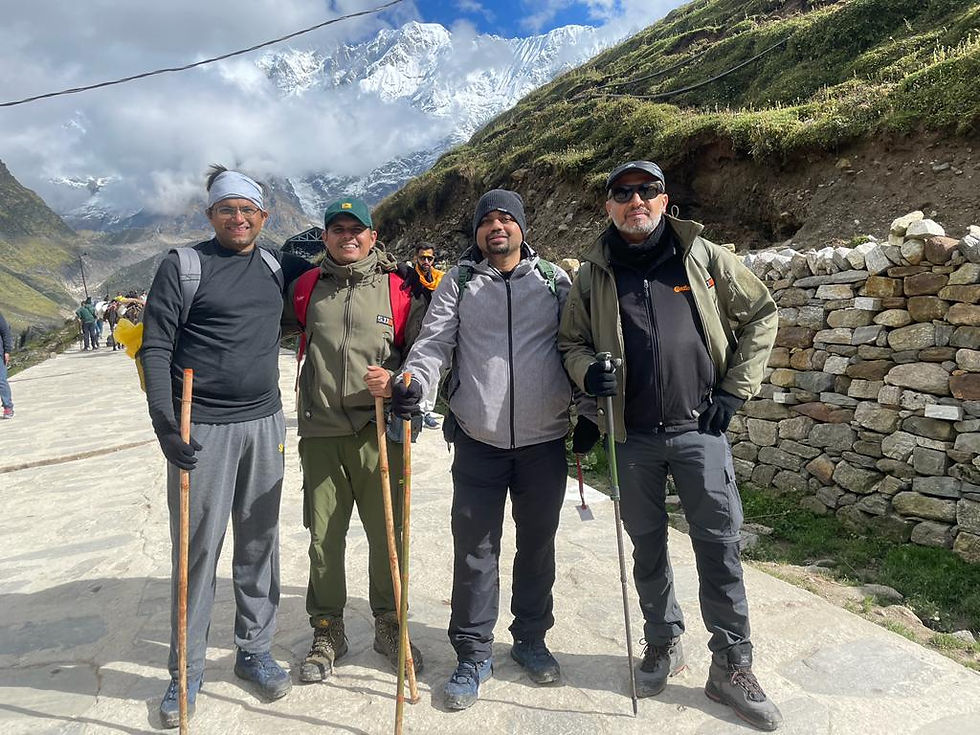
The Medical Pitstop. Despite the spiritual recharge, my body was lagging. Andy steered me into the government medical center. They gave me some high-altitude meds, and within 15 minutes, the fog in my head cleared. However, I made an executive decision. "I will take the horse down," I announced. The guys agreed instantly. They didn't want a medical emergency on the trail, and frankly, neither did I.
The "Legs of Steel." I hopped onto a mule. The journey down took less than half the time. I chatted with the horse keeper running alongside. "How many times do you do this?" I asked. "Twice daily, Sir," he replied casually. Twice daily. That means he walks 44 km every single day on steep terrain. I looked at my trembling legs and then at his. We city folks have no idea what real fitness looks like.
The Casualty Count. Almost towards the final leg, I stopped for tea. Suddenly, I saw a familiar face on a passing horse. It was Jitu. "What happened to him?" I wondered. He was supposed to be the walker.
15 minutes later, Andy and Teja arrived on foot (show-offs) and broke the news. "Jitu had a muscle tear. He couldn't walk anymore."
The Kedarnath Scorecard:
Teja & Andy: Completed the entire round trip on foot. (Status: Legends/Maniacs).
Me: Altitude sickness + Stomach pain. (Status: Horse Down).
Jitu: Leg injury. (Status: Horse Down).
The Return Drive: Waking Up from the Dream.
We were back at Gaurikund, broken but satisfied. Andy called our driver, and he arrived to pick us up. The Plan: Head to Dehradun (approx. 250 km / 7 hours). We calculated we would reach by 10:00 PM. The Obstacle: Our driver. He dropped a bomb: "Sir, driving on mountains is not allowed after 8:00 PM." We argued. We did the math. We told him, "We will be at the base of the mountains by 8 PM, and after that, it’s all plains. It’s safe." But this guy was immovable. He wasn't driving the ghats at night. Period. The Compromise: We finally made a deal. We would drive as far as we could. If we were still in the mountains by 8:00 PM, we would halt at Devprayag. If we cleared the hills, we pushed to Dehradun. With the pact sealed, we moved on.
The Great Descent. After the intense physical and spiritual high of Kedarnath, the drive back felt like slowly waking up from a vivid dream. The air got thicker, the temperature rose, and the landscape shifted from rugged alpine rock to lush, subtropical green.
Leg 1: The Mandakini Farewell (Gaurikund -> Rudraprayag) We were essentially rewinding our journey, but this time driving with the flow of the river, not against it.
The Visuals: The valley opened up. The jagged, snowy peaks of Kedarnath slowly receded in the rearview mirror—a poignant moment for the blog (and our hearts).
The Vibe: The car was silent. Most of us were asleep, exhausted from the trek. The Mandakini River raced us to the bottom.
Emotional Checkpoint: Reaching Rudraprayag. This was it. The Mandakini—the river whose roar filled our nights—ended here. It merged quietly into the Alaknanda. It felt like saying goodbye to a faithful travel companion.

Leg 2: The Urban Shift (Rudraprayag -> Srinagar) As we left Rudraprayag, the road widened. We were now following the Alaknanda.
Culture Shock: About an hour later, we hit Srinagar (Garhwal), the largest town in the hills. Suddenly—Traffic lights! College campuses! Crowded markets! After days of Himalayan silence, the honking horns felt like a shock to the system.
The Heat: The air was significantly warmer. One by one, the heavy jackets came off. We were returning to the land of mortals.

Leg 3: The Scenic Run (Srinagar -> Devprayag) The valley became wide and the road relatively smooth.
Vegetation Shift: The Pine and Deodar trees of the high altitude disappeared, replaced by Mango and Banyan trees.
The Arrival: Finally, we saw the suspension bridges of Devprayag. We had come full circle. We started the trip by seeking the source, and now we had returned to the confluence where the Ganga is born.

The Halt: Devprayag.
By the time we reached Devprayag, it was 7:30 PM. There was no way we were making it to the plains before the driver’s 8 PM curfew. So, we honored the deal and halted at a small hotel.
The Roommates (Again). We checked in and dumped our bags. Same couples as always: Andy & Me; Teja & Jitu. I cannot stress this enough: A hot shower after 4 days of trekking is a spiritual experience. We scrubbed off the dust, the sweat, and the mule smell, finally feeling human again.
The Celebration. We squeezed in a small celebration before dinner.
Drinks: A few stiff ones to numb the sore legs.
Chakna: Whatever Namkeen packets we had left in our bags. "Cheers," we said. To survival. To Shiva. To the legs of steel (not ours).
The Ice Cream Victory. Dinner was standard Roti, Rice, and Dal. But the highlight came after. We spotted a shop selling ice cream. For the last 5 days, we had treated cold water like poison. But now, in the warmer air of Devprayag, we rebelled. We indulged. We stood there in the pleasant evening air, eating ice cream cones like kids on a summer break.
The Proposal (One Last Trek?). But before we could crash, Andy and Teja dropped a bomb. "Let's go to the Devprayag Sangam in the morning," they said. Technically, it’s not a mountain trek. But to reach the confluence, you have to descend 200 steep steps. After walking 18 km at Kedarnath, 200 steps felt like 2,000.
The Split Decision:
Summit Team (Andy/Teja): Eager.
Survival Team (Me/Jitu): Skeptical. "I will decide when I wake up," I said diplomatically. (Translation: There is a 99% chance I am sleeping in).
We went back to our beds. For the first time in days, there was no altitude sickness, no stomach pain, no bee stings, and no freezing temperatures. Just four tired guys crashing out in comfortable beds.
Day 6 was officially done.
Day 7: To Dehradun. Finally.
We were in no rush today. For the first time in a week, there was no trek leader shouting, no driver honking, and no fear of missing a sunset. We woke up around 7:00 AM—which, compared to our usual 4:00 AM starts, felt like noon.
The Great Divide. As predicted, the group split into two distinct factions:
Faction A (The Machines): Andy and Teja. They were up, laced up, and ready to trek down 200 steps to the Devprayag Sangam.
Faction B (The Smart Ones): Jitu and Me. We were barely conscious.
The Moment of Truth. In our room, Andy stood over my bed, looking annoyingly energetic. "Walking down?" he asked. I pulled the blanket over my head. "NO." In the other room, the scene was identical. Teja asked Jitu. Jitu, pointing to his injured leg (and his general lack of interest in stairs), gave a resounding: "NO."
So, the unstoppable forces of nature headed down to witness the holy confluence. Meanwhile, Jitu and I did something equally spiritual: We went back to sleep.
The Sangam: Where Two Become One. Our real trekkers took about 15 minutes to run downhill and get up close to the Devprayag Sangam. It looks beautiful, calm, and scary at the same time. When you stand at the corner (the tip of the confluence), on your left you see the Bhagirathi (turbulent, muddy, and noisy, rushing from Gomukh) and on your right is the Alaknanda (calm, deep, and a stunning shade of emerald/teal, coming from Badrinath).
And when they meet, the noise settles, the colors merge, and you get the beautiful, wide, and holy view of the Ganga.
Andy at Devprayag Sangam Devprayag Sangam up close
An hour later, the "Summit Team" returned, sweaty and filled with divine vibes. They found us exactly where they left us. We finally decided to join the living world, grabbed a simple breakfast of Chai and Paratha, and by 11:00 AM, we hit the road for our final destination: Dehradun.
Andy, Jitu and Girish in car Teja in car
The Re-entry to Reality: Devprayag to Dehradun.
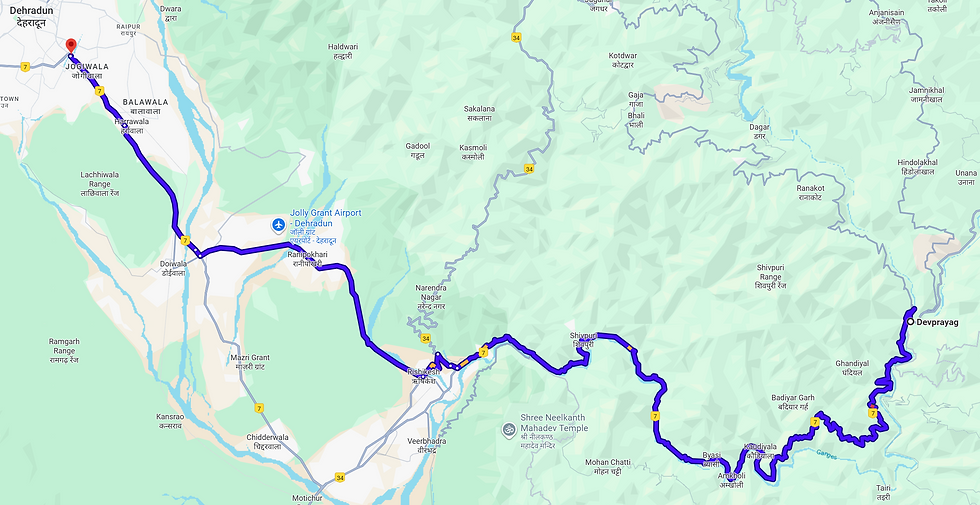
The 115 km drive is visually distinct. It captures the exact moment you transition from the rugged Himalayas to the flat plains. You are essentially following the Ganga as she leaves her mountain home.
Leg 1: The "Rafter’s Run" (Devprayag -> Rishikesh). For 70 km, the Ganga flows to your right. But she looks different here—wide, majestic, and a stunning shade of aquamarine.
The Shift: The vertical cliffs soften into white sandy beaches.
The Tourist Signal: Suddenly, the river is dotted with bright rubber rafts. You hear screams of excitement from rafters hitting the rapids.
The Bottleneck: Shivpuri. The road gets narrow and crowded with rafts being loaded onto jeeps. It’s chaotic, dusty, and a stark contrast to the silence of Kedarnath.

Leg 2: The Gateway (Rishikesh Bypass). As we hit Tapovan, the silence was officially gone. It was replaced by the honking of tempos, the smell of diesel, and the sight of yoga cafes.
The Reality Check: This is the physical reminder that the trip is ending. We peeled off our fleece jackets here. The air got heavier and humid.
The Glance: We caught a fleeting glimpse of the Ram Jhula and Laxman Jhula bridges before the highway swiftly carried us away from the chaos.
Leg 3: The Forest Tunnel (Rishikesh -> Dehradun). This was the most relaxing part (approx. 45 mins).
The Vibe: Winding mountain roads replaced by straight, flat tarmac cutting through Rajaji National Park.
The Canopy: We drove through dense Sal forests. Sunbeams filtered through the leaves, creating a hypnotic strobe-light effect on the windshield.
The Symbol: Passing Jolly Grant Airport—the ultimate "The End" symbol for any travelogue.

Arrival: Hotel JSR Continental. We reached our base: Hotel JSR Continental. Compared to the homestays, this felt like a palace. It’s a 4-star hotel on the main highway with actual room service, reliable hot water, and mattresses that don’t feel like rocks.
The Roommates (The Divorce Clause). We dumped ourselves into the rooms. The "couples" didn't want to divorce, so we maintained the status quo:
Room 1: Andy and Me.
Room 2: Teja and Jitu.
We just lay on the beds, staring at the ceiling, enjoying the air conditioning. The altitude lethargy had hit us hard. The Strategy Lunch: We ordered a minimal lunch. Why? Because the evening was reserved for "Hogging." We wanted to eat everything in sight for dinner, so we saved our appetite.
The Marathon Chat & The 4 PM Alarm.
After lunch, we didn't go back to the rooms. We just sat in the restaurant. For the first time, we weren't talking about routes, altitude, weather, or injuries. We just talked. We chatted about everything—friends, family, work, and the golden vault of "Old School Days." There is a specific kind of comfort in sitting with guys who have known you since you were wearing half-pants to school. You don't realize how time flies.
The Realization. Suddenly, someone checked their watch. "Bhai, 4 baj gaye." (Bro, it's 4 PM). We had killed two hours just sitting in chairs. We realized we were wasting precious city time. Mission: Sightseeing (to pretend we are tourists) and Hogging (the real goal).
City Mode: Activated. We rushed back to the rooms. Gone were the trekking pants and muddy boots. Out came the jeans and fresh shirts. We sprayed enough deodorant to mask the memories of the last 6 days and headed out. Dehradun awaited.
The Great Dehradun Hogging & The Sleeping Beauty.
The Warm-Up Lap. We started with street food basics: Samosas and Lassi. It was delicious, but we reminded ourselves: “Focus, guys. This is just the warm-up.”
The Main Event: Bungalow Bar & Kitchen. We headed to the Bungalow Bar & Kitchen in Crossroads Mall. Stepping inside felt like teleporting from a freezing canvas tent to a chic, upscale lounge. It’s one of the most "Instagrammable" spots in Dehradun. Since it was a weekday, we got a prime spot with enough privacy to be our loud selves.
The Menu: A Global Tour We didn't hold back.
Drinks: Citrus Mojitos (Fresh, bright, and loaded with white rum).
Small Plates: Teriyaki Chicken Baos and Truffle Cream Cheese Dumplings.
The Heavy Hitters: Thai Green Curry, Chipotle Burrito Bowls, and Smoked Minced Steak Burgers.
Dessert: Bungalow Tres Leches Cake and Biscoff Caramel Brownie.
Citrus Mojitos Chicken Bosco Boys in resturant
The Night Flow. The night played out like clockwork: Drinks. Food. Laughter. Repeat. That warm, content feeling of a journey well done hung in the air. We were clean, fed, and happy.
The Teja Incident (System Shutdown). But the exhaustion of the trip hadn't fully left us. Teja was the first casualty. By the time we asked for the bill, his battery hit 0%. He literally fell asleep on the chair in the middle of a loud bar.
A cynic might say he was pretending to sleep to avoid paying his share. But looking at his face, we knew he was genuinely knocked out. The Response: Did we let him sleep peacefully? Of course not. We are his best friends. We quietly pulled out our phones and conducted a photoshoot of "Sleeping Beauty." We got every angle. Eventually, we shook him awake. He looked around, confused, wondering if he was still on a horse in Kedarnath.
Teja sleeping Teja sleeping and Andy laughing
The Final Crash. We headed back to the hotel and collapsed into the luxurious beds. After nights of sleeping bags, this felt like sleeping on a cloud. Day 7 ended on a full stomach.
Next day's plan: We will see when we wake up.
Day 8: The Art of Doing Nothing.
The Anti-Morning. We had no alarms for today. After a week of 6 AM wake-up calls, freezing cold showers, and 18 km treks, today was dedicated to the most important activity of all: Absolutely Nothing. We were awake, staring at the ceiling, but physically, we were on strike. We weren't ready to face the world, or even the floor.
The Invasion. Then, a knock on the door. Andy opened it. It was Teja. He looked like he had just rolled out of bed—hair messy, eyes half-open. My heart stopped. I had a PTSD flashback: Is he going to suggest a morning walk? Is there another Sangam to see? Fearing the worst, I instinctively slipped deep under my blanket, pretending to be asleep (or dead).
The Pile-Up. Surprisingly, Teja didn't say a word. He just walked over and jumped into our bed. Now, the bed contained three living, breathing, but entirely motionless friends. Then the fourth guy stepped in—Jitu. He stood at the door, looked at the pile of humanity on the mattress, and asked, "Arre tum log kya kar rahe ho?" (What are you guys doing?). We didn't answer. We didn't have to. He shrugged, walked over, and he too collapsed onto the bed.
The Vibe. Now there were four grown men lying on one hotel bed, staring at the ceiling, doing absolutely nothing. And it was perfect. Andy hit play on his speaker. Soft music filled the room. No one spoke. No one moved. We just lay there, soaking in the luxury of inactivity.
The Hunger Games: Zombie Edition.
It was 9:30 AM. The peace was broken when the "Fat Guy" (Me) realized a critical truth: Breakfast closes at 10:30. My stomach sounded the alarm. The spell was broken.
The Hygiene Standard: Low. We slipped out of bed with the coordination of synchronized swimmers who had given up on life.
Bath? No.
Change clothes? Absolutely not.
Brush teeth? Yes. (We are savages, but we have standards).
The Walk of Pride. We marched down to the restaurant. Picture this: It’s a nice 4-star hotel. There are families in crisp shirts, business travelers in suits, and couples looking fresh. And then there was us. Four grown men in gym shorts, crumpled t-shirts that hadn't seen an iron in 8 days, and hair that defied gravity. We looked like we had just escaped a shipwreck. Did we care? No. We walked straight to the buffet line. Because after climbing Kedarnath, social anxiety doesn't exist.
The Buffet Strategy: Divide and Conquer.
A full breakfast buffet lay before us—North Indian, South Indian, Continental, Bakery. A normal person would choose what they like. But we are not normal people. We are full-grown, "sophisticated" men. And sophisticated men have a system.
We looked at the spread and realized we wanted to eat all of it. But walking back and forth is inefficient. So, we developed a tactical plan: The Quarter-Split.
Zone 1 (Andy): He handled the first section. He didn't just take a serving; he took 4 pieces of every single item in his zone.
Zone 2 (Teja): Second section. Copy-paste strategy.
Zone 3 (Me): I handled the third section. No discrimination between sweet and savory.
Zone 4 (Jitu): He swept up the remaining items.
We walked back to the table balancing mountains of food. People around us were eating muesli and single slices of toast. We had created a miniature food mountain in the middle of our table. That is how four full-grown men show sophistication. We didn't choose. We conquered.
The Pool, The Prohibition, and The Redemption.
30 minutes later, the plates were spotless. We went back to our default setting: Doing Nothing. The Hygiene Hack: Suddenly, a realization hit us: We still hadn't bathed. Then, Jitu spotted the holy grail through the window: The Swimming Pool. Why take a shower like normal people when you can take a community bath? We rushed to change into our "swimming costumes" (aka: just another pair of shorts).
The Private Pool Party. We jumped in. The other guests took one look at us—four disheveled guys who looked like they had just walked out of a jungle—and decided, "Yeah, maybe we'll swim later." We had the whole pool to ourselves.
Bosco Boys swimming
The Prohibition. The setting was perfect. The only thing missing was a cold beer. We ordered beers. The Rejection: The Manager marched over, stern-faced. "Sir, no drinks allowed in the pool." We were heartbroken. But we are law-abiding citizens. We obeyed.
The Loophole. We climbed out, dripping wet, walked five steps away from the "pool area," and sat at a table in the open-air restaurant. We looked at the waiter. "Now?" The Manager smiled. Technically, we were following the rules. He gave the nod.
The Storyteller Discount. As we sipped our beers in soaking wet clothes, the Manager came over to chat. We told him our story—the bee sting, the altitude sickness, the 18 km walk, and the "legs of steel." By the end, his face changed from strict enforcement to pure regret. His expression said it all: "Damn. I should have just let these guys drink in the pool."
The Afternoon Loop: Rinse & Repeat.
Eventually, it was time for lunch. We went back to our rooms and actually took showers this time (civilization restored). We headed back to the restaurant feeling clean and ready for Round 2.
The Routine: Same as breakfast.
The Strategy: The "Quarter-Split."
The Result: We ate everything on the buffet.
We are men of tradition, and we take our traditions seriously. After lunch, we didn't move. We sat, we chatted, and we watched the sun go down over Dehradun. It was the perfect lazy afternoon.
The Evening: The Intellectual Interlude.
Evening arrived, bringing with it the thirst for drinks and conversation. Teja invited an old IIM classmate who lived in Dehradun. This guy held a high-ranking position in a government organization. We gathered in Teja and Jitu’s room. The Vibe: Teja and his friend launched into a deep conversation about "IIM Days," corporate strategies, and government policies. The Audience (Us): Andy, Jitu, and I sat there, sipping our drinks, nodding occasionally, and smiling as if we understood macroeconomic theory. He was an interesting guy, but we were just happy to be spectators.
The Soya Chaap Chronicles.
Once the friend left, we switched back from "Intellectual Mode" to "Sophisticated Gluttony Mode." We moved to Andy and my room for dinner. The Manager: Teja was in charge of ordering.
Round 1: The Discovery. Teja ordered Soya Chaap, Chicken Chilly and more. When it arrived, it was delicious. Spicy, tender, perfect chakna. It vanished in no time.
Round 2: The Crime. Teja was still on duty. He liked the Soya Chaap so much that for the second round, he ordered only Soya Chaap. We trusted him. We didn't check the cart. When the food arrived, Andy, Jitu, and I looked at Teja like he was a war criminal. "Bro, seriously? Just this?" We wanted to bash him. Not that the Soya Chaap tasted bad, but who orders the same thing and the only thing for dinner? We had no choice. We finished it.
Round 3: The Addiction. Teja was officially fired. I took charge of the phone. The Order: Proper Starters and Main Course - both veg and non-veg. Just as I was about to hit "Place Order," a voice shouted from the sofa: "Ek Soya Chaap bhi add kar de!" It was Teja. He was addicted. The Rule: e don't dissatisfy a friend. I sighed and added it.
The Climax. By the time the food arrived, Teja was fast asleep on the sofa. The Big Question: Who is going to eat this third round of Soya Chaap? Andy, Jitu, and I were starting to hate the very sight of it. But the golden rule is: We Don't Waste Food. We shook Teja awake. He ate one bite, mumbled something, and passed out again. We grumbled, we struggled, but we finished the dinner.
Bedtime. Jitu dragged Teja back to their room. Andy and I threw ourselves on the bed, and the lights went out in seconds. The day was relaxing. What did we do? Absolutely Nothing. And it was glorious.
Day 9: Back to Mumbai (The Reality Check).
We got up by 7:00 AM. The vibe had shifted. The trek was over. The vacation was over. The "Nothing Days" were done. It was time to go back to our regular lives—emails, traffic, client meetings, and the humidity of Mumbai. With that heavy thought, we got ready.
The Strategic Starvation. By 8:00 AM, we were at the restaurant. This time, we were actually sophisticated. We didn't pile our plates high. We had a light breakfast. The Reason: The Airport Lounge was calling. As loyal Indian bank card holders, it is our constitutional duty to save stomach space for "complementary" food. We skipped the buffet to honor the lounge.
The Bollywood Exit.
By 9:00 AM, we were checked out and ready to book a cab. To our surprise, a premium car was already waiting at the entrance. We looked around, confused. "Who booked this?"
Then Teja walked out like a hero in a Bollywood movie slow-motion shot, putting on his sunglasses. "It's for us," he said casually. "My friend from yesterday sent it." Status: Legend. The driver loaded our bags, and we drove off to Jolly Grant Airport in style.
The Lounge: Expectation vs. Reality.
We reached the airport in 30 minutes. Security was smooth. Then came the ritual: The Lounge Visit. We walked in expecting luxury. What we found was a glorified cafeteria.
The Spread: Simple. 5-6 dishes, juice, and coffee.
The Crowd: It seemed every passenger in Dehradun had the same credit card. The place was packed.
The Strategy: Musical Chairs. We managed to find exactly two seats for four people. Did we leave? No. We improvised.
The Rotation: Two of us sat and ate. Two of us stood and ate. Then we swapped. It wasn't comfortable. We were eating standing up while holding luggage. But it was complimentary, so it tasted like victory.
The Goodbye.
In about 30 minutes, boarding started. We walked to the plane, taking that slow walk. As the flight took off, we glued our faces to the window for one last look at the mountains.
"Bye Bye Dehradun," we whispered. "Until next year." (Or whenever we forget the pain and decide to punish our legs again).
We landed in Mumbai a few hours later. The cool mountain air was replaced by the warm, sticky hug of the city. The trip was over. The memories were permanent.
And that concludes the Chronicles of the Bosco Trekkers.
Final Words from Wanderlust Foodies.
We often say "Food is God," but on this trip, we learned that finding actual God (or at least His temple) takes a lot more effort than finding a good restaurant.
If there is one takeaway from these 9 days, it’s that comfort is overrated. The softest bed in Mumbai can’t compete with the relief of finally peeling off your trekking boots after 22 kilometers. And no gourmet meal in a 5-star hotel will ever taste as good as that third round of Soya Chaap we forced ourselves to eat because we were too tired to argue.
We started this journey as four guys looking for a break, but we returned as a brotherhood forged in freezing tents and fueled by rum and painkillers. We survived bee stings, altitude sickness, stomach bugs, and the indignity of being overtaken by mules.
The Bottom Line: If this group—comprising one walking wounded, one sick guy on a horse, and two fitness freaks with terrible singing voices—can make it to the doorstep of Kedarnath, then you have absolutely no excuse.
The mountains don't care about your fitness level; they only care about your will to keep moving (even if that movement is on a horse).
So pack your bags, bring extra socks, and go find your own path to the divine.
Until the next adventure (or the next Soya Chaap), Keep Wandering, Keep Eating.


Comments